On-demand webinar coming soon...


On-demand webinar coming soon...

Blog

The Missing Layer in AI Governance

Moving from AI governance inputs to programmatic governance outcomes.


Jaimin Patel
Principal Solutions Engineer
October 8, 2026

Abstract white architectural panels with vertical glowing light lines forming a symmetrical corridor.

Over the last few years, organizations have made significant investments in AI governance. They’ve built AI inventories, established responsible AI policies, introduced AI assessments, and adopted monitoring and observability techniques. These capabilities have helped organizations understand where AI is being used, what risks may exist, and how AI systems behave.

But many enterprises are learning that visibility alone isn’t enough.  

The Challenge With Today’s AI Governance Programs

An inventory can identify an AI system. An assessment can identify risk. Monitoring can reveal changes in behavior. But governance teams are increasingly finding themselves asking a different set of questions:

  • Who owns this use case?
  • What action is required when risk is identified?
  • Does the use case align with existing policies and risk frameworks?
  • How are exceptions managed?
  • How can decisions be documented and demonstrated over time?

The challenge is no longer collecting governance information. The challenge is connecting governance decisions, accountability, and oversight into a repeatable process that can scale across the enterprise.

As AI adoption accelerates, organizations are realizing that discovering AI is only the beginning. The harder challenge is governing it continuously as systems, data, models, and agents evolve.

The Shift Toward Programmatic Governance

This is where the market is heading. Organizations have invested heavily in discovery, assessment, policy, and monitoring capabilities. The next phase of maturity is connecting those activities into a governance operating model.

Programmatic governance is emerging as the missing link between governance activities and continuous oversight. It connects inventory, assessments, policy requirements, ownership, approvals, risk decisions, and evidence management into a single framework that remains consistent throughout the AI lifecycle.  

Rather than treating governance as a collection of disconnected activities, organizations can establish a repeatable process that supports oversight from initial AI intake through deployment, monitoring, and ongoing review.

The goal is not simply to identify risk. The goal is to ensure risk can be managed consistently as AI systems evolve.

How OneTrust Helps Operationalize Governance

This is where OneTrust helps organizations move from governance inputs to governance outcomes.

At the programmatic governance layer, organizations can inventory AI systems and use cases, perform AI assessments, establish accountability, align controls to existing risk frameworks, manage governance workflows, and maintain evidence of governance decisions. These capabilities provide the operational foundation needed to scale AI governance across the enterprise.
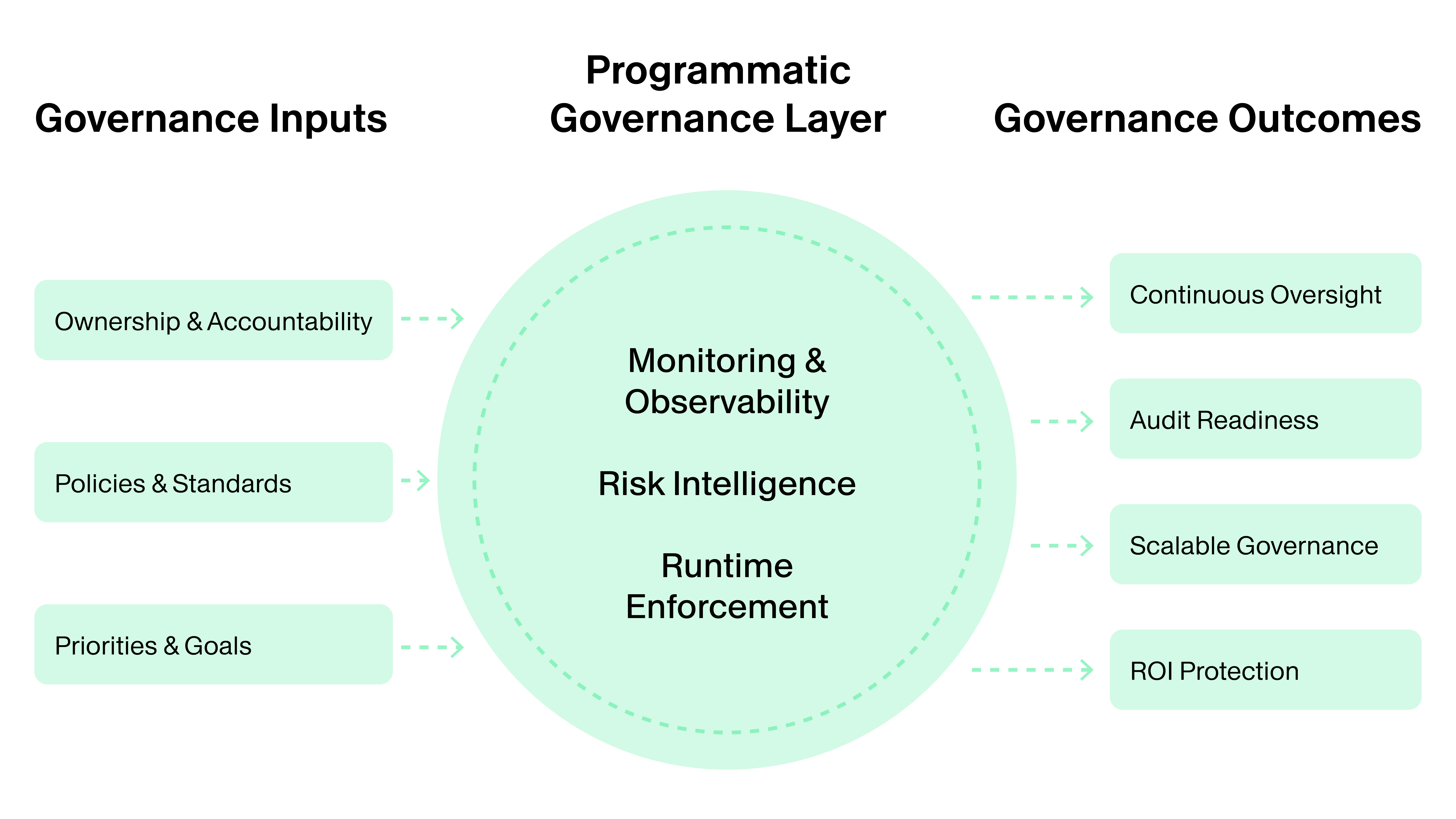

 

Diagram showing how governance inputs flow through a programmatic governance layer to produce governance outcomes. On the left, governance inputs include Ownership & Accountability, Policies & Standards, and Priorities & Goals. Arrows point to a central programmatic governance layer consisting of Monitoring & Observability, Risk Intelligence, and Runtime Enforcement. Arrows then point to governance outcomes on the right: Continuous Oversight, Audit Readiness, Scalable Governance, and ROI Protection. The graphic illustrates how governance inputs are operationalized through automated governance processes to achieve oversight, compliance, scalability, and business value.


As AI systems move into production, governance must remain connected to how those systems operate in practice. This is where technical governance extends programmatic governance beyond assessments and approvals.

Capabilities such as AI Guard SDK make it easier to onboard and govern AI agents regardless of where they are developed or deployed, helping organizations bring locally developed and custom AI applications into the governance process with minimal operational overhead. At the same time, Shadow AI discovery helps identify unmanaged or unknown AI activity occurring across the enterprise, improving visibility into systems that may be operating outside established governance workflows.

Governance must also extend beyond visibility and into enforcement. Through runtime policy enforcement and guardrails, organizations can apply approved policies closer to where AI systems, copilots, models, and agents are operating, helping ensure governance decisions remain aligned with real-world behavior.

Combined with OneTrust's established risk, compliance, privacy, and data governance capabilities, organizations can manage AI within the same governance framework that already exists across the enterprise. As AI adoption expands across platforms, models, agents, and business workflows, programmatic governance and technical governance work together to create a continuous governance model that connects risk, policy, accountability, oversight, and enforcement across the AI lifecycle.

Governance Must Become Operational

As AI becomes omnipresent across business processes, applications, and agents, governance can no longer operate as a series of isolated reviews, assessments, and approvals.

The next phase of AI maturity requires governance to become an operational capability embedded into how AI is introduced, deployed, and managed across the enterprise.

That is the role of programmatic governance: not as another governance activity, but as the framework that brings together risk, accountability, oversight, and enforcement into a repeatable operating model for AI.

The organizations that succeed will not be the ones with the most governance artifacts. They will be the ones that can operationalize governance at the same pace they adopt and scale AI.

Find out more about the technical aspects of AI governance with this field implementation guide.